
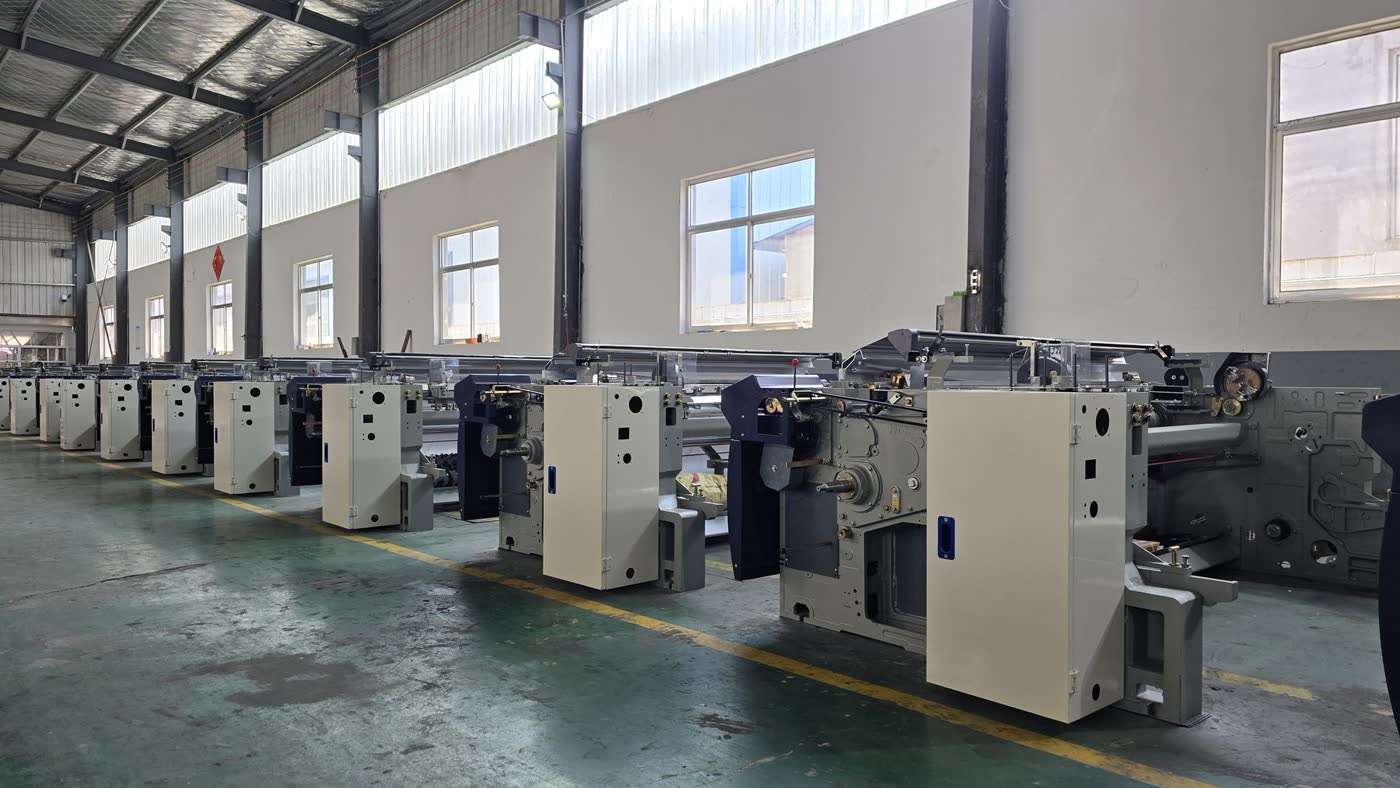
A model name alone does not define the complete loom. Use the JTM508 table together with the system explanations, then ask which items are standard, optional, or selected specifically for your project.
SYSTEM OVERVIEW
Read the loom as a coordinated production system
Think of the loom as one production system. The frame and drive provide the mechanical base. The insertion system moves the weft, while shedding, beat-up, detection, cutting, and leno devices form the fabric and its edges. Let-off, take-up, lubrication, control, filtration, suction, and drainage support consistent operation.
- Frame, drive, and beat-up
- Pump, nozzle, feeder, clamp, and weft detector
- Crank, cam, or electronic-dobby shedding
- Let-off, take-up, leno selvage, scissors, and control
JTM508 SYSTEM MAP
JTM508 systems and reference specifications
| Application | |
|---|---|
| Model | JTM508 shuttleless waterjet loom |
| Fabric application | Polyester, nylon and other hydrophobic synthetic filament fabrics |
| Nominal reed space | 190 cm and 280 cm reference configurations; other widths are confirmed by project |
| Machine Body | |
| Machine body | HT250 gray-cast-iron left and right side-frame assemblies, approximately 570 kg combined, with pentagonal connecting beams |
| Floor fixing | Eight main floor anchors, four on each side; center supports follow the approved installation drawing |
| Corrosion protection | Phosphating, electrophoretic coating, three protective paint coats and 304 stainless-steel fasteners and covers |
| Weft & Shedding | |
| Pump / nozzle | 1 pump / 2 nozzles or 2 pumps / 2 nozzles, selected by the weft plan and fabric |
| Shedding | Crank; NPW410, NPW411 or LP409 cam; NP5400D electronic dobby |
| Heald frames | 8, 10 or 12 frames, subject to shedding system and weave |
| Drive & Control | |
| Let-off / take-up | Mechanical or electronic, selected by tension and pick-density requirements |
| Control | XINLIAO 7-inch HMI reference configuration |
| Main motor | 5.5 kW direct-drive X-Motor or conventional belt-driven motor |
WEFT AND SHEDDING
Evaluate pump, nozzle, and shedding together
For reliable insertion, water pressure and volume must match the nozzle, timing, yarn, width, running speed, and shed geometry. Shedding is selected from the weave repeat and required heald frames. A larger pump or more complex shedding system is useful only when the fabric needs it.
QUOTATION SCOPE
Confirm what is included before comparing price
Ask every supplier to clearly list the standard machine, project options, excluded items, component brands, spare parts, packing, commissioning, warranty, and support. The same model name can still represent a very different technical scope.
- Confirmed fabric and production assumptions
- Included systems, brands, and option codes
- Excluded utilities, accessories, and installation work
- Packing, delivery, training, warranty, and spare parts
PERFORMANCE CONFIRMATION
Use the target fabric as the acceptance basis
Real speed and output depend on the yarn, fabric construction, width, preparation, shedding, insertion setting, water, and operator practice. A more dependable approach is to confirm performance on the intended fabric, or an agreed reference fabric, rather than relying on one universal maximum-speed number.
Need a specification comparison for your fabric?
Share the fabric construction, finished width, yarn details, weave repeat, and target output. JETMECH will prepare a clear configuration scope and explain the points that need your confirmation.